Showing posts with label Chaloner. Show all posts

Wednesday, September 6, 2017

There is Nothing Civil about War


By Bob Ferris

All this talk about a potential civil war in this country really makes me a little anxious. I have always taken a certain pride in the fact that nearly all my ancestors on both sides of my family fought to preserve the Union. In our family we did not have brothers fighting brothers or fathers fighting sons. We collectively seemed to know what we were about.  But we were not always that way, particularly if we jump back another two centuries to the English Civil War or more properly characterized as the Wars of the Three Kingdoms.  I suppose since this series of conflicts was started with a prayerbook that we could also call it the War of Three Religions (Episcopal, Presbyterian and Catholic). 


I will admit here that this series of conflicts has always confused me because of its multidimensional nature.  Some argue that it was simply about the rich and the poor.  Others say it was over governance.   And we also see it reduced to Cavaliers and Roundheads like it was some near-decade-long Super Bowl.  But this ignores the roles of kings, popes, bishops and parliaments.  My sense is that it was more a soupy conflict of all these elements and more, regardless of what Hobbes, Marx and others say.  

Sir Oliver Cromwell 
I dropped into this topic while still researching some of the links exposed from my investigations of my family’s Graham roots in the borderlands between England and Scotland.  One of the threads in question dealt with the Chanoler family of Guisborough in Northern Yorkshire and their connections to the Ingoldsby family.  Anne Ingoldsby’s mother was a woman named Elizabeth Cromwell.  Certainly a familiar surname and then I saw it.  Her father was Sir Oliver Cromwell.  Crap.

The Slaughter after the Siege of Drogheda in 1649
My reaction was prompted by the Fortescues.   An ancestor by the name of Faithful Fortescue lost two sons including our direct ancestor Chichester at the First Siege of Drogheda in 1641-42.  The Fortescues decamped from Drogheda soon thereafter but when Lord Protector Oliver Cromwell attacked and defeated the place in 1649 he put many of the residents to the sword in a notorious massacre. The good news is that “our” Sir Oliver (pictured above) was the Lord Protector's uncle and not him. 

Sir Faithful Fortescue
Sir Faithful is an interesting fellow in this as he was a Royalist and then fought with Cromwell briefly only to head to Scotland to the royalist side once again. He exemplifies the labile nature of allegiances in this series of wars.  Perhaps this is why he went by the nickname of "Faskie" in Scotland.

All of this is a long-winded way of saying that this potential “civil war” that folks such as Alex Jones and Roger Stone are banging drums for is more multidimensional like the series of English conflicts than what we saw during the 1860s in this land.  The Three Kingdoms conflict became so complicated because everyone was upset but they were upset for different reasons and in the end they had separate visions.  Folks in Ireland and Scotland both fought Cromwell and his New Model Army but for different reasons and with disparate end goals in mind.  My sense is that this type of amalgam slips easily into conflict but does not drift so easily towards resolution of any lasting consequence. 
  
Sir James Graham
In thinking about this I return to the Grahams—in particular James Graham of Montrose—more relative than ancestor.  James believed in the monarchy balancing Parliament, but felt that the Presbyterian clergy should play mainly in the realm of spirit rather than politics.  In his fight he was able to enlist the largely Catholic Highland Scots as well as the Royalists in Ireland.    In the current context I cannot help but compare this to Trump’s cabinet and those in his executive circle—together in conflict but not resolution.  This same comment could be made about this weird alliance of the very rich, very religious and very hateful stirred and heated from afar by the very envious.  


It should be remembered as we look backwards for clues about the future that tearing something down or destroying the beneficial accomplishments of others is much, much different than building a positive and jointly held vision that helps us all.  Now many may scoff at genealogy as vanity but it is also history and perhaps through it we can learn of our ancestors' triumphs as well as their failures and follies.  Perhaps through this exercise we can strive for the former and avoid the latter.

Friday, September 1, 2017

The Need for Graham Crackers


By Bob Ferris

I think at times that the above is what I need.  Folks who can "crack" the mysteries of our two Grahams—James and Richard—two men who arrived in the Colonies in separate centuries as if dropped from thin Scottish air.  Interestingly, they were both rumored to be connected to notable men in ways that seemed perhaps impossible.  But still the rumors persisted and for a lot of good and bad reasons. Let's start with one un-cracked and finish with the one that is confusing but more certain. 


James Graham sailed from Great Britain on the Blossom with newly appointed Governor Edmund Andros in 1678 at the time when England took possession of the Dutch Colony renaming it New York.  James was a mover and shaker quickly becoming an Alderman, the first recorder of New York City, and serving in the legislature in addition to being Attorney General under differing political configurations.  He also liked his "cyder" evidently and was famously stabbed and nearly killed by Captain Jarvis Baxter after they imbibed.  In short, he had a big footprint in the colonies but a surprisingly clouded past in Scotland.  

From A Dictionary of Scottish Emigrants to the US
The written record on James varies.  Some sources just jump to him being the son or grandson of James Graham the Marquis of Montrose and then move on.  Other sources acknowledge this has been claimed and then offer up a close relation hypothesis because of his having the family seal.  None of these approaches gains virtue through actual evidence but only because of repetition. Many sources give John Graham as his father and Isabella (Isobella or Isabel) as this mother.  His purported mother's maiden name is given variously as Auchinleck, Affleck or Affick which are related in a fashion.  I just do not know for certain.

Auchinleck House in the area where this Isabella would have lived. The house was build a century later.
James Graham Marquis of Montrose did have a son named John but that son died in 1645 at the age of 15 before our James was born.  James of Montrose did have other sons but they were either well documented as not being our guy's father or too young to have a child in the 1650-1656 period in question. I thank the kind and responsive folks at the 1st Marquis of Montrose Society in Scotland and the Clan Graham Society on this side of the pond for helping me sort possibilities and rule out those that are obviously incorrect.  Much appreciated.

This is a mystery and one that is hard to abandon because of the oft repeated myths and the story of the seal which no one seems to know about anymore.  The connection makes sense and more tendrils of clues emerge because the lands held in New Jersey by Gov. Lewis Morris and Isabella Graham Morris were called Monmouth in honor of the Morris roots in Wales but within those lands is also the town of Montrose, New Jersey a head nod to the Grahams.  So the mystery remains and the clues tug at us.


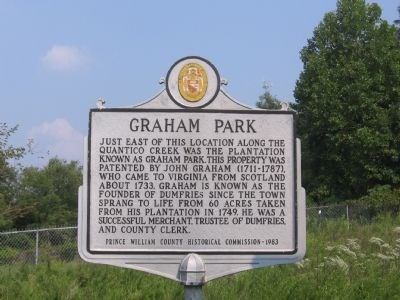
Richard Graham is another ancestor that needed cracking.  At first glance he seems, like James Graham, a Lowland Scot who appeared or was born in North America fully-hatched with unclear roots.  He, like ancestor Patrick Ramsay's son Andrew who married Richard's daughter Catherine (see above), was associated with Dumfries, Virginia named after the same in Scotland.  Dumfries was founded by John Graham who was born in 1711 but John is not Richard's father as he did not seem to have a son named Richard although John did appear to have connections with the Grahams of Montrose.


Patrick Ramsay was a merchant tied through his father Andrew Ramsay to the so-called tobacco lords of Glasgow.   Graham was a merchant as well first associated with the firm of Morris and Nicholson out of Philadelphia that had Robert Morris, signer of the Declaration of Independence and financier of the American Revolution, as a controlling partner.  Graham dealt in tobacco also but was more of a land speculator occasionally connected to the likes of George Washington (1),  Thomas Jefferson (1) and George Mason IV (Richard's son George married the widow of George Mason V).  In the letter cited to Thomas Jefferson, Richard writes that he has connections to the Marquis of Graham (6th Marquis of Montrose) but does not define those.  It all confuses.

From here written by George Mason Graham Stafford grandson of George Mason Graham.

In terms of purported links to great ancestors, I was given a genealogy at one point that claimed Richard was related to the Grahams of Norton-Conyers in Northern Yorkshire.  Since this felt like a stretch and no documentation was given I was dubious.  That was until I found the above account that linked our Richard through his grandson George Mason Graham to Reginald Graham, the second Baronet of Norton-Conyers.  There are Richard Grahams in this line, however, the dates appeared to not line up.   The Sir Reginald in question died in 1728 which makes it unlikely he fathered a child ca. 1755 and our Richard Graham lived with the Dumfries crowd and claimed an association with Montrose.

From here.
Then I found the above hint and was able to backtrack and find that Reginald Graham, second Baronet, did indeed have a son named Richard (1,2) who married a woman named Cordelia Chaloner in Cumberland County, England. I was also able to find numerous mentions of their two sons Richard and Reginald Graham in Dumfries, Virginia so I continued to look and then located a reference to a Reginald Graham who died in 1782 and whose estate was administered by George Graham, William Carr and Richard Graham.  Though not absolutely certain, this is a much more solid place than where I started.

Norton-Conyers Manor home of the Grahams since 1624 and supposedly the inspiration for Thornfield Hall in Jane Eyre. 
Accepting this lineage opens a large door in our line that travels to Sir Richard Graham, the first Baronet of Norton-Conyers and to his father Sir Richard Graham (1) of Esk.  It even leads us to Fergus Graham of Plomp.  But there it re-enters the murk as evidence gets thin when trying to document links with the likes of Mathias (Matthew) Graham or John of the Bright Sword.  It seems appropriate though as these Grahams lived for centuries in the borderlands between Scotland and England which included Cumberland and also an area know as the Debatable Land.  Debatable, indeed.


Perhaps I look at this in a backwards manner for both James and Richard.  Maybe they are the roots themselves?  In the critical two centuries of this nation's transformation from colonies to country and then the protection of that entity through three wars these two dropped many important acorns (see below). It is interesting in this that when the children of William Walton Morris and George Douglas Ramsay married during the Civil War they brought together the Montrose and Menteith elements of the Clan Graham again.  It is always nice when symmetry is obtained.

Partial List of James and Elizabeth Graham's Descendants:
Isabella Graham Morris, First Lady of New Jersey
Robert Hunter Morris, Governor of Pennsylvania
Lewis Morris III, Signer of the Declaration of Independence
Gouverneur Morris, Writer of much of the US Constitution
General Staats Long Morris, British General serving in India and then Governor of the Quebec Garrison
Honorable Richard Morris, Chief Justice New York Supreme Court
Lewis Richard Morris, US Congressman
General William Walton Morris, Civil War General

Partial List of Richard and Jane Graham's Descendants:
Captain George Graham, Calvary Captain in the War of 1812 and Acting Secretary of War under James Madison.
John Graham, Diplomat
George Mason Graham, West Point Graduate and the Father of Louisiana State University
General George Douglas Ramsay, Chief of Ordinance for the Union during Civil War
Admiral Francis Ramsay, Civil War Ship Captain and Chief of the Navy's Bureau of Navigation