Showing posts with label Gales. Show all posts

Wednesday, July 10, 2019

American Liberty as an N-Dimensional Hypervolume


By Bob Ferris (this is cross-post from my Green Dreams site)

I have always been fascinated with the concept of an ecological niche being characterized as a n-dimensional hyper-volume defined by an infinite number of changing and interacting bio-physical factors.  Phew.  It makes my mind happy.  I like to think about stuff like this on my morning beach walks.  Unfortunately, this idea recently collided with an electronic discussion that I had involving members of a Libertarian organization trying to imply that Oregon was heading towards a "civil war." Their evidence was the recent corporate-sponsored senior prank executed by a group of Republican legislators who walked out and hid during the legislative session to avoid a vote they knew they would lose on cap and trade legislation.  A baby step towards doing something about climate change.  My discussions with the Libertarians really came down to a disagreement over liberty and how it was defined.


The group headquartered in the Northeast and wanting to spread its wings geographically sided with the pranksters as well as the militias and repeatedly argued that you were either with them (i.e., for liberty) or you were a Communist.  There did not seem to be any middle ground.  The bold boys (and they were all male) evidently held that liberty was a single point or maybe a collection of points along a line or in a geometric plane that was free from regulations, taxation, or any form of governmental control or interference.  I disagreed as my sense is that liberty as it was envisioned for the country is more of a hypervolume just like those ecological niches.

I suppose that liberty can be a jumble of points or perhaps a line if you have one person living on a desert island all alone.  But add another person to that island and liberty becomes an exercise of protecting your own and not compromising another's.  Liberty in a multi-person context becomes a set of rights and responsibilities.  No longer can you sing show tunes at three in the morning or pee wherever you want.  With each additional person the structure of liberty and the approaches to protect it become more and more complex.  I think the Founding Fathers understood the tricky and interactive nature of national-scale liberty.


When I was in school I was taught one idea per sentence and one theme per paragraph.  I suspect that Gouverneur Morris who wrote the Preamble was taught that too (in at least a couple of languages) and I suspect that is why the Preamble of the US Constitution reads like a carefully ordered recipe for achieving the desired level of liberty, for the most, and for the longest possible time.  Given the sensitivity for the individual, it was probably an optimization approach rather than one designed for maximization.  I would think that the nod to some individual liberties is a little like the carbon added to iron to make it steel (see below quote).  The iron and carbon analogy is helpful when looking at liberty as our Libertarian friends want all the carbon (personal liberty) they can get which is the recipe for steel blades that break or what is commonly known as pig iron.

“the dignity or moral importance of persons may compensate numbers.” Francis Hutcheson (1694-1746)
Essentially, American Liberty is probably a kind of a highest common denominator concept.  Moreover, this single-sentence paragraph weaves the fabric of national-scale liberty in a manner which implies that weakening any or all of these contributing factors lessens the probability of the latter.  It also is a cloth colored by inclusive words such as union, common, general, and our which give structure to the idea and set the theme of this applying to all of us together.  Roughly a century later Minister Francis Bellamy [1] wrote the Pledge of Allegiance that echoed this collective idea of "liberty and justice for all."  But others came before either.
"The good and happiness of the members, that is the majority of the members of the state, is the great standard by which every thing relating to that state must finally be determined." Joseph Priestley in The First Principles of Government and the Nature of Political, Civil and Religious Liberty (1768)
When you look at the above quote, and similar writings by Francis Hutcheson [2], Jeremy Bentham and other Utilitarians (all influenced by Epicurus), you understand too that the inherent principles of the Preamble did not form in isolation but came from other thinking before, during, and beyond the Revolution.  Few know Priestley now but he can be thought of as the Albert Einstein [3] of the 18th century in that he was a prominent scientist, theologian, and philosopher who left his native England for the intellectual freedom of America.   Joseph was also a friend of Thomas Jefferson as evidenced by more than 150 letters that passed between them and Dr. Priestley is said to have had a "...disproportionate influence on the men who wrote the Declaration of Independence and who framed the Constitution of the United States."

"...convinced that by ruining my family and distressing my friends by risking either, would only gratify the ignorant and malignant, I shall seek that livelihood in another land which I cannot peaceably gain in this."  Joseph Gales Sr. 1794
Priestley was also active in the founding and promotion of the Christian Unitarian Church which acted to reconcile religion and science and attracted the likes of English journalist Joseph Gales Sr and his wife Winifred Marshall who were chased out of England at about the same time as Priestley in 1794.  Gales was a friend of Thomas Paine and published Paine's works as well as those of Priestley.  I know Joseph and Winifred and this story because they are the last immigrants in my bloodline to come to the new world.  I remember a lot of these lost players and discussions for family reasons but others over the years have remembered them as well.

Gifford Pinchot in setting up the US Forest Service coined the phrase: The greatest good to the greatest number of people for the longest time.  His slogan riffs on the words of Jeremy Bentham and also incorporates themes expressed in the Preamble by adding the dimension of time.  Pinchot would have appreciated the idea of the hypervolume as he embraced science and helped found the Yale School of Forestry with the backing of his father.  Pinchot and his brother Amos also joined with Theodore Roosevelt in 1912 in the founding of the Progressive Party which became know as the Bull Moose Party when Republicans of the times were divorcing themselves from the conservation movement launched by Roosevelt and others such as John Muir.  Additionally, Roosevelt was also a fan of Gouverneur Morris so much so that he wrote his biography.

But back to the idea of American Liberty as a hypervolume.  Some might object to my mixing of this scientific terminology with the political.  Too eggheaded.  Too complicated.  I do it for two reasons.  The first is that my idea of ideal liberty is probably different than yours which means that my liberty is defined by a different axis (i.e., dimension) or volume (set of axises) than yours.  Much as I'd like to think mine is a straight and consistent vector it is not and changes with time and conditions as I suspect the vectors of others do as well.  We are human too so we blink on and then off, we multiply, and we move.  Since a hypervolume happens when the dimensions number four or more we are clearly there with nearly 330 million of these often squiggly constructs to consider.


My second reason for using the term is that it is applied to a concept developed nearly two and half centuries ago by some extremely well-educated men who fully embraced the most modern and scientific concepts of their time.  They were hungry for these ideas and proudly carried the banner of the Age of Reason.  I am confident that they would embrace this or something similar to this usage.  They would gravitate to the most complicated and then slice it and dice it in order to understand it. 

In ecological niches those conditions within the confines of the hypervolume tend to support the critter's existence and those outside tend not to.  Viewed through this ecological lens the fossil fuel industry externalizing the environmental costs of their pollution and corrupting legislatures to facilitate that while curbing needed actions on climate change would clearly be outside of even the most generous interpretation of this optimized hypervolume of liberties.  The same would be true of operations like Walmart where society enables the family's profits by subsidizing their workforce while greasing the skids of our manufacturing decline and adding to trade deficits with China.   And I would add that this hypervolume defined by the Preamble would not include nor even consider the notion that everyone has the right to own whatever ordinance in whatever amount they so desire just so arms companies can expand or maintain sales in times of relative peace and that individuals can spray the landscape with lead.  Translated into biological terms it is easy to see why conditions equivalent to these would limit the life expectancy of an animal or population.   Why is it so hard to understand that in the world of the economic and political?

As one can see from the above and the supporting notes below I feel that the Declaration of Independence, the Revolutionary War, and the US Constitution are a little like a Family and Friends plan [4].  This is probably why I was so offended by Trump's 4th of July performance where it was all about the military and very little about the Founding Fathers on the day meant to celebrate their ideas, courage, and sacrifice.  It is like wanting to celebrate the achievements of the honor society at a school but spending your time talking about the football team.  But it is more than that.

The Founding Fathers were thought leaders taking us away from the blind faith and mysticism of religion (while maintaining the best of its moral teachings) and towards developing science and enlightenment.  That is why thinkers, scientists, and journalists like Paine, Priestly, and Gales came to America and flourished [5].  Trump, his evangelical choir willing to believe anything, and others like those who freaked out when the Declaration of Independence was tweeted by NPR in 2017 or the Libertarian group above are madly throwing salt on the fertile fields where this great experiment was launched.  It is not hard to imagine hearing the sound of 56 disapproving cane tips pounding angrily on the floor of Independence Hall in protest.  Hopefully enough others hear the din too in order to affect change.

*****

On a More Personal Note:

[1]
"Bellamy was a Christian socialist who "championed 'the rights of working people and the equal distribution of economic resources, which he believed was inherent in the teachings of Jesus.'" In 1891, Bellamy was "forced from his Boston pulpit for preaching against the evils of capitalism", and eventually stopped attending church altogether after moving to Florida, reportedly because of the racism he witnessed there. Francis's career as a preacher ended because of his tendency to describe Jesus as a socialist. In the 21st century, Bellamy is considered an early American democratic socialist."  From Wikipedia biography of Francis Bellamy
It is interestingly ironic that elements of the forces that argue for the more individualistic and selfish vision of liberty often cling to and revere both the "We the People" phrase and the Pledge of Allegiance not knowing the history of either nor the strongly held beliefs of the authors.  Gouverneur Morris who penned the Preamble and most of the Constitution was an advocate of a strong federal government who wanted to limit state power.  Reverend Bellamy was a Socialist Christian minister who also believed in an absolute separation between church and state.  Both men have ties to Revolutionary War financier Robert Morris in that Gouverneur worked for the older and unrelated Robert and Francis was born in Mount Morris, New York that was named to honor the gentleman who stepped forward with money when it was needed.  My mother read a biography of Robert Morris while she was pregnant with me.  My middle name of Morris relates to brothers Lewis and Gouverneur, but my mother insists that my love of fishing comes from her reading that book as Robert Morris loved to fish and often did so with George Washington and Gouverneur Morris (see Washington as an Angler here)

[2] Francis Hutcheson was a prominent Presbyterian minister and educator in Dublin at the same time as my ancestor Robert Alexander was training for the ministry before heading to the Colonies in 1736.  It would have been hard for Robert not to have had contact with Francis and his ideas.  And harder still for Robert to not pass lessons learned on to his students at the Augusta Academy which eventually became Washington and Lee University after spending time being Liberty Academy about the time of the Revolution.  Robert's grandson Archibald was the fourth president of Hampden-Sydney College (James Madison and Patrick Henry were early trustees) and the founding president of Princeton Theological Seminary.  Hampden-Sydney named for two champions of and martyrs to personal and religious liberty (John Hampden and Algernon Sydney) and started in late 1775 near settlements of displaced Scotch-Irish in Virginia was probably like a match thrown in a pile of already warmed gunpowder.
"Indeed, the original students eagerly committed themselves to the revolutionary effort, organized a militia-company, drilled regularly, and went off to the defenses of Williamsburg, and of Petersburg, in 1777 and 1778 respectively. Their uniform of hunting-shirts - dyed purple with the juice of pokeberries - and grey trousers justifies the College's traditional colors, garnet and grey."  From the History of Hampden-Sydney College.
[3] It has also been said that Priestley was the Abbie Hoffman of his time but I think that works for Thomas Paine better.  It is illustrative to read Paine's critique of Gouverneur's oration at the funeral of Alexander Hamilton to get a notion how Paine might attack those who were once colleagues when they digressed from the purity of Paine's democratic vision.  There is a little bit of the personal here as Gouverneur had both a withered arm and was missing a leg.   I suspect much of that was due to Gouverneur's lack of effort to get Paine released from French prison when Morris was serving as American Minister to France, Paine was a man of fans and detractors.

[4] I have often struggled with the task of characterizing how and where my family participated in the events leading up to the American Revolution and the forming of this nation which is an exercise every bit as complicated as this notion of a hypervolume.  Some of it is easy.  Lewis Morris signed the Declaration of Independence as a representative of New York.  Lewis and the Lewises who came before him are direct ancestors making Gouverneur Morris a long ago uncle celebrated in the middle names of my great-grandfather and my grandmother.  Similarly Joseph Gales Sr. is remembered in the names of my great-great-grandfather, great-uncle, and my sister.  George Washington was a friend of Gouverneur's, but also of Quaker ancestor Benjamin Chew and dined with a young Andrew Ramsay and his wife at Mount Vernon.  It goes on and on much like a well-stirred bowl of spaghetti with strands of angry and educated Scotch-Irish from Ulster, a smattering of exiled Scots that didn't bounce first in Ireland, a fistful of Huguenots, and a collection of Englishmen and women booted or pushed across the pond for various reasons--some religious and others political.  Been there, done that, have the t-shirt.  

[5]

[] I believe that the reverse of this is true as well in that scientists want to leave or not go to areas that do not welcome or respect new ideas or eduction.  The Agricultural Department scientists objecting to being transferred from Washington, DC where 53% of the population have college degrees to Kansas City where only 33% have obtained this level of education is a good example of scientists gravitating to or wanting to stay in areas of enlightenment rather than those where education appears less valued.

Saturday, June 30, 2018

For the Revolutionary War Our Family Turned it Up Above Eleven and Now We Need More


By Bob Ferris

I have butted heads with the so-called "patriot" groups over the years on various matters relating to the US Constitution, conservation practices, and public lands.  One group in particular drives me crazy: The 3 Percenters.  This para-military group claims to be the voice of those 3% of Americans who served in militias during the American Revolution.  This number is a little specious both in terms of a measure of patriotism (i.e., militia members being more patriotic than those in the Continental Army) and gross numbers as overall participation in this conflict was something like 15 percent.  It made me wonder where our family came out in this number and what that means now and in the future.

The Revolutionary War started in earnest 243 years ago.  As male generations are on average 35 years long, or 15 years longer than female generations, that means we should be talking about males in the seven or eight generation or between 64-128 potential soldiers in the Revolution.   As we have at least 17 Revolutionary War combatants in our tree or 13-26 percent of our expected pool that means that we might have collectively served a little less or a lot more than the average population at 15 percent.

But it is more complicated than that.   For one thing, males had to be a certain age (16-55) during a certain window of time (1775-1783) so we might have had some who were alive during war, but too old or too young.  This said we also had instances where both father and son served such as Declaration Signer Lewis Morris and Lt. William Walton Morris (not to be confused with his son Gen. William Walton Morris who served in the Civil War).   And we had a few who were not in the country at this time such as Patrick Ramsay (Scotland), William Poyntell (England), and Joseph Gales Sr. (England), the latter my family's most recent immigrant (1790s). 

David Deschler

Joseph Tatnall
Benjamin Chew

Also mainly through my great-grandmother Caroline Johnston Canby Ramsay on my father's side, there is a strong Quaker connection.  Three of note were David Deschler, Joseph Tatnall, and Benjamin Chew.  Interestingly, all three hosted George Washington in their homes at times, but they dealt with their pacifism and the war in different manners.  David was perhaps the most involved providing supplies, money, and eventually serving as the Commissary of the Army in 1780.    David was also a man of principle supporting the Revolution, but also once defending a British officer who was traveling with his family from an angry crowd of militia members in Philadelphia.  Joseph Tatnall, a mill owner, also worked hard to keep the Continental Army in flour and had constant contact with Washington.  Benjamin Chew stuck to his material neutrality offering only legal advice to those serving in the Continental Congress and advocating for protest leading to a peaceful resolution rather than declaring independence.  While David and Joseph retained the full goodwill of their neighbors and new countrymen, Benjamin's road, because of his why-can't-we-all-be-friends approach, was rougher.

Those who served were old and young.  Though my mother has told me often of a little drummer lad in the family who went to war I have yet to discover that intrepid boy.  The youngest I have been able to find is Ensign John DePeyster Douw who joined at 19.  The oldest was Colonel Samuel Coit who led his Connecticut regiment for a year before being replaced at age 73.  They also came from nearly every colony so there was diversity in this regard if not in other areas.
"Mrs. Johnston died in that city, but we have no record of the date of her death or where interred."  In Some Pennsylvania Women during the War of the Revolution (1898 see here).
But what about the women?  The above quote says a lot about that issue.  The Mrs. Johnston in question was Alice Erwin Johnston wife of Colonel Francis Johnston and she broke with her Quaker community and worked hard to get food and supplies to soldiers during the war.  This was particularly true about Valley Forge where her husband served with Washington and another Francis (Chaffin) who died there of small pox even with the efforts of Alice and her allies.  Luckily, we actually do know where Alice was buried and then reburied, but even in a book dedicated to acknowledging the role of women in the Revolution details about women were omitted or overlooked.  Odd that.

This walk through history is interesting but how do we judge it and our collective role?  What does it mean for the future?  In essence, what is the point?  My sense is that revolution is much like soil tilling in that it gives a clean slate on which to grow dreams like those expressed by Gouverneur Morris in the Preamble.  Perhaps we should not be measured by the quality or quantity of our disturbance as I have documented above, but by the crops ultimately produced.   And even there my desire would be that we evaluate ourselves more by the flowers nourished and enabled rather than just in terms beets and broccoli.

Alexander Johnston Cassatt by Mary Cassatt.  Alexander helped his sister promote her art in the US.  They are both great-great grandchildren of Alexander Johnston who immigrated from Ireland and was father to Francis.  
Our families have a lot of these exceptional "flowers" growing from various branches.  I bumped into two, in addition to Alice Johnston, while writing this piece.  The first was the impressionist painter Mary Cassatt who called Colonel Francis Johnston great-great uncle.  I knew of her connection to the Johnston line but not of her brother's efforts on her behalf.  The other was Lillie Hitchcock Coit of San Francisco's Coit Tower fame who was married for a time to Benjamin Howard Coit great-great-great grandson of Colonel Samuel Coit.  In this in-laws count just as transplants do in a garden.


Illustration from one of Mary Lanman Douw's books.  The Rapelye (Rapalje) cradle was where Sarah Joris Rapalje was rocked after being born in the New Netherlands in 1625.  She was the first female child born in the new colony at Fort Orange (Albany).

In addition to a painter and fire-chasing, trouser-wearing philanthropist in our extended family we also have writers.  One such was Mary Lanman Douw who wrote much about history, genealogy, and the early Dutch experience in the New World.   Nina Chandler Murray is another author who penned a book about an epic family cruise to the Galapagos Islands.  I would also include Winifred Marshall Gales, the first female novelist in North Carolina, within this group too even though she was in England during the Revolution, because her public sympathy to this revolt and breaking away led to her and her husband Joseph Gales Sr. being chased out of England one step in front to the law.   The fact that the Gales entertained folks like Thomas Paine of Common Sense fame in their home and printed some of his material probably helped along this process of moving from liking the American stance to being American.

Award-winning teacher Lauren Bergland Rosenberg at work.

My grandmother Edna Dora Robb also was one of these flowers.  She wrote about her experiences in post-World War I Alaska in Field and Stream Magazine, but she is better known as a school teacher who as a single woman went to the relative wilds of Seward to teach before marrying my grandfather at the start of the Roaring Twenties.  And there are other teachers too like second cousins once removed Lauren Bergland Rosenberg (above) and Patty Lavarias who are both probably going to look at my grammar. 


In closing, I will say that we are living in dark times, but the strength, creativity, and sensibility of the women in our families and lines gives me hope.  I gain this feeling, because these women might be the ones who inspire or lead this next revolutionary adjustment or needed democratic booster shot.  Maybe they can do so in a better and more enlightened manner than our more recent forbearers did in the mid-1800s.  It might also be good time for those of us not women to model Alexander Cassatt by recognizing this talent, however different, and supporting it.

The above is something that we should think about this July 4th as we celebrate the work of our Founding Fathers and simultaneously mourn how far we have drifted away from our founding principles and the vision expressed in the US Constitution.  We need to return to protecting all within our country from the corrupting forces of a too-empowered elite, over-entitled corporate interests, and the dangerous re-emergence of the functional equivalent of a state church or religion.  We should recognize this trio for what they are: the catalysts for the original Revolution.  So enjoy the fireworks, but get your shoes ready to march on as the fife and drum are calling!
 

Monday, September 11, 2017

Mistaken in Maryland

The Mark of Richard Johns on a piece of pottery from Angelica Knoll in Maryland (Note: He was a Quaker rather than a Catholic)
By Bob Ferris

I might have, once or twice, when I first moved to Maryland called Johns Hopkins University incorrectly John Hopkins thinking it titled after a person named John rather than someone named Johns Hopkins honoring the melding of two early Quaker families in Maryland.  I was corrected and learned.  Fancy that.  Then I filed away this information until I started looking at the collection of ancestors that I had in Maryland--many of them from the Society of Friends or Quakers.

This took me to Richard Johns, Elizabeth Kensey (Kinsey) and a place called Angelica Knoll.  The Johns were very active Quakers, but at the same time not strict in all their beliefs and practices.  Richard Johns (1) was devout enough to help establish a Friends Meeting House (1,2,3) near their home called the Clifts or Cliffs close to Calvert Cliffs which was visited by Quaker Founder George Fox.  Yet Richard consumed hard cider and brandy as well as having an extensive library.  Richard also did not dress drably as others of the sect did.

Initials on a "bodkin" found at Angelica Knoll that likely belonged to Margaret Johns (Is could be Js.) 

Elizabeth and Richard also had children which made the Clifts and Angelica Knoll something of a familial epicenter of sorts.  Why a family epicenter?  Well, Richard and Elizabeth (1) had two daughters, Pricilla and Margaret.  Pricilla married Robert Roberts (the elder) who went north from Maryland and is an ancestor of my father William Ramsay Ferris.  Pricilla married into a line that eventually connected with the Canbys (1,2) and my great-grandmother Caroline Johnston Canby who many of us knew as Nana.  Nana remained a Quaker and in this light it is interesting that she married into so military a family as the Ramsays.


And Margaret Johns married Gerard Hopkins who are ancestors on my mother's side.  The Hopkins' line moved west appropriately marrying into the West family and eventually connecting to the Settles family in Pike County, Missouri.   My mother was born Mary Robb Settles.

The Descendants of Pricilla and Margaret Johns reunited in a single family after more than three centuries (Front Row (L-R): William Ramsay Ferris and Mary Robb Ferris [Settles]. Rear Row (L-R) William Ramsay Ferris Jr, Mary [Gales] Ferris Siebert, Caroline Robb Hall [Ferris], Robert Morris Ferris.) 
As both my parents had ancestors on the Mayflower their families had nearly 400 years to mix and create common ancestors. It is interesting given this time and opportunity that Richard and Elizabeth Johns seem to be my parents' only common ancestors on this continent.  (There may be more, but I have not found them.)
Johns Hopkins
Of note in the beginning context are Margaret and Gerard (Gerrard) Hopkins.  This couple celebrated both their families by naming one of their sons Johns Hopkins.   That first Johns Hopkins also had a grandson of the same name born in Crofton, Maryland in 1795 who attended the Anne Arundel Free School in nearby Davidsonville, Maryland for a time (1807-1809).   Johns Hopkins was an astute businessman and investor who became very, very rich and was able to retire at the age of 52.

That later Johns Hopkins ended life childless having fallen deeply in love with his first cousin Elizabeth who he was forbidden by their religion and custom to marry.   In fact, neither of them ever wed and John Hopkins took his money--some seven million dollars--and put these funds and others towards Johns Hopkins University and the hospital that also bears his name as well as an orphanage specifically for children of color.   This latter action is of significance as Johns Hopkins' family owned slaves which they released in 1807 and Johns Hopkins was a prominent Abolitionist.
“...slavery was perfectly acceptable provided that slave owners attended to the spiritual and material needs of those they enslaved.” On Quaker attitudes towards slavery in Slavery in Colonial America, 1619-1776 by Betty Wood
My sense is that we cannot heap praise on Johns Hopkins for his actions and attitudes without at the same time acknowledging that many of our ancestors, including those of a Quaker or "friendly" persuasion like the Johns, Chews and Galloways in Maryland, owned slaves.  They were not alone as something like 70% of Quakers owned slaves near the turn of the 18th century.   And, yes, the Quakers were among the first in the Colonies to push back on the practice reducing ownerships to 10% by the mid-1700s and very early on joining the Abolitionist cause.  But they were owners regardless of how benignly they treated those removed from their homes in Africa and elsewhere.  And perhaps while we argue for all to model Johns Hopkins' philanthropy and tolerance we should also offer up a certain openness to discuss this other difficult topic as well.  Seems like all these actions are need now more than ever.


Saturday, June 24, 2017

Revolution Redux for the 4th in Four Stories

Bill Ferris and Bob Ferris in Friday Harbor, Washington. Nereid is a nymph but also the name of ship in a novel by Patrick O'Brian.  There are connections and parallels everywhere.
By Bob Ferris

My father read books all the time.  I do too.  So before Carlene and I left on this last trip I hit most of our Friendly Neighborhood mini-libraries and finished off my book search off at Saint Vincent DePaul—a good place for paperbacks.  The first book I read was called 1812 by David Nevin (1996). This book is a mixture of fact and informed supposition giving insights on key characters and events in the War of 1812.  Nevin does a good job of covering a complicated and nuanced situation.  He touches on the major battles and tells us tales about Aaron Burr, Daniel Webster, Winfield Scott, James Madison and, of course, Dolley.  

USS Chesapeake
There were lots of reasons why we fought Britain again but nearly all fall into three pigeon holes.  The first being impressment of our sailors exemplified by the brazen attack on the USS Chesapeake by the HMS Leopard on June 22, 1807.   (Coincidentally, the refitted HMS Leopard is also a main “character” of an audio book, Desolation Island, by the late Patrick O’Brian that Carlene and I are now enjoying as we drive.) 

The second reason is a broad category related to foreign trade, particularly with France.  We argued that we were a neutral country but our trade was being hampered by England through blockades, attacks and acts of harassment.  All suffered in this but the New England states—which characterized this conflict as a southern and western war—seemed most hard hit and so argued loudest for quick and peaceful resolution.  Noted orator Daniel Webster was one who campaigned strongly against the war though he did not support the Hartford Convention or the calls from some for a New England succession.  


In many ways this was simply a continuation of the Federalist (Anglo-centric) versus Jeffersonian (Franco-centric) debate which was forestalled by the ten-year duration of the Jay Treaty that expired in 1806.    Reading much about the politics of this era makes your head spin (i.e., nothing changes).  It is tough to encapsulate but if you imagine an extremely contentious divorce where both sides had affairs and the parties are still trying to occupy the same house you get a sense of it.  

And the territorial confusion was not just with England but between states and other countries including Spain.
And then there were Britain’s various actions—both large and small—directed at hampering our young country’s desire for western expansion.  The Jay Treaty removed concentrated British military presence from the ceded lands of what was known as the Northwest then.  But there was still a sense of the British messing with these frontier lands.  I cannot help but think that this is somewhat analogous to the Russian situation now in that the incursion is clearly going on but it is often difficult to sort out the specifics.
    
Taken collectively this situation was much about respect with the town bully still thinking the wiry and rustic farm boy had laid him out with a lucky punch.  We did, but the question was whether or not we could do it again.  In my reading I felt drawn for a number of reasons more to those actions on the frontier and to Andrew Jackson—for good and bad—the unruly, junkyard dog we probably needed at this critical time.  

Certainly there are opportunities for vigorous debate about whether or not we had any reasonable right to conquer or acquire these lands from those here long before us but soldiers died, money changed hands, and documents were written for legality’s sake if not morality’s.  It is a wheel that has rolled for countless centuries on wagons driven by virtually every people. 

I think history becomes more real when painted with people.  And our family was peppered across the entirety of this event including the frontier.  So I thought this 4th I would share some sketches to make this often forgotten or diminished war more real.  Some of these are just wisps of smoke whispered in written accounts, Bible scribblings or verbally, but they help personalize these events and make them less abstract.  Some speak directly while others imply or encourage informed supposition.  


Cruelty, valor, greed and tragedy all lived in these lands at this time and our collective family experienced it all as well as that feeling of hope likely shared by all pioneers. There was probably hatred too in all quarters as the American rebels had altered the normal course and rebelled against rulers.  These “rabble” discarded rules and killed officers which was seen as a sin in a hierarchical setting but considered strategic expedience in a land bent on equality.  And the natives trying to keep their ancestral homes often doled out savagery and played one exploiter against the other.  In short, it was war where mantles of anger and self-righteousness are easily donned and everyone can play aggressor or victim by simply flying on the wings of an outcome.  


Story One: Life on the Frontier


John KW Waller from the 1790 Tax Rolls in Spotsylvania County where he still held property.  
Two episodes from the Robb side of our family give a glimpse of the tenuous nature of frontier life leading up to the war.   The first involves a man of Welsh descent by the name of John Waller.  John was born in Virginia in 1739.  He called himself “KW” because he was raised in King William County, Virginia and this was his way of differentiating himself from the John Wallers before and those to come.  KW fought in the Revolution and then moved to Kentucky with his wife Mary Small and their children in the 1780s.  They settled in Jefferson County (now Washington County) on Cartwright Creek eventually moving in 1806 to Henderson County when the area became "too populated" with Catholics for their Protestant sensibilities (see 1,2,3).   

The rolling hills around present-day Cartwright's Creek.
Sometime (likely prior to 1806 but one source says 1811) KW and some others travelled to the "falls" in the Louisville area.  They were attacked by Indians on the way and this John Waller was wounded and captured.  He escaped two years later and it is said that KW's delay was driven by his desire to wait until both he and his fellow captive could make their escape together.  Since his pack horse returned without him his family thought him dead for this period.

During this same post-Revolutionary period James and Margaret Barr Robb moved to Kentucky from Pennsylvania. James was a Scotch-Irish emigre who fled Ireland in 1774 when he was to be jailed for smuggling sassafras tea on his ship.  With the help of friends he, a pregnant Margaret, and their children fled to the Colonies only to go from one frying pan into another.  James served in a militia during the Revolution and they all moved to the Mann’s Lick area near present-day Louisville.

James was quite a hunter and trapper. I found one account (which misidentified James as David Barr Robb) that claimed he was part of a group who took a large shipment of furs down the Mississippi to New Orleans.  They then reportedly sailed towards Philadelphia only to be captured by pirates.  James eventually made it back but not until one year after he was presumed dead.  

There are take-home messages from the above and hundreds of other similar tales.  Clearly life on the frontier during this period was perilous and tricky.  Encounters with Indians on the frontier could result in undesired outcomes.  And many of these settler families were founded by fathers who had fought in the Revolution and likely passed anti-British sentiments onto their children.


Story Two: The First Battle


During the same period that the Robbs and Wallers were moving between Kentucky and Indiana so was the family of Abraham Lincoln.  Here are pictures from Lincoln Boyhood National Memorial in Lincoln City, Indiana.   Carlene Marie Ramus (top).  Caroline Hall and Bob Ferris (bottom).
By the early 1800s the Wallers and Robbs were connected by marriage with some moving across the Ohio into southern Indiana to present-day Posey and Gibson counties.  Here we find John Thomas Robb along with his brothers David Barr and James.  John Thomas married Lydia Waller and her brother John was with them.

David Barr Robb married Nancy Eckley whose father Lt. Joseph Eckley was killed by Indians working for British forces during the Revolution at “Battle Island” in Pennsylvania.  Moreover, David was a reader too and he often borrowed books from a neighbor whose name was William Henry Harrison. Given sentiments, experience and associations it is not really a huge surprise that David, James and brother-in-law John Waller soon found themselves at a place called Tippecanoe on November 7, 1811 serving under General Harrison as captain, corporal and ensign respectively. Captain David Robb’s company (see center of map below) did well and he brought his brother and brother-in-law home alive through James was shot through both legs.  Tippecanoe is considered by many as the first major battle of the War of 1812.  

Tippecanoe Battle Plan showing deployment of Captain Robb's forces.
The Battle of Tippecanoe severely dampened the hopes of the charismatic Shawnee Chief Tecumseh to form a broad native confederation to forestall western expansion of the US. Tecumseh eventually died fighting on the British side at the Battle of the Thames on October 5, 1813.  David Barr Robb went on to elected office serving both in the Indiana House and Senate along with helping craft the Indiana Constitution.  David also lived long enough to see his book-lending friend elected President of the United States in1840. Harrison died soon after taking office, but probably not from his lack of hat, gloves and overcoat during his long inaugural address as has been rumored.

The toppled and neglected gravesite of David Barr Robb (Rebecca Childers)

Story Three: Remember the Raisin


As a child my wife used to wade in the Raisin River near Monroe, Michigan.  There Carlene had little to do but avoid the dangers of pesky crawdads, but it was not always so.  This area, once know as Frenchtown, was the site of a series of battles fought during the period of January 18-23, 1813.  The first engagement was a slight victory for the Americans but the last is typically referred to as a massacre with many, mainly from Kentucky, on the receiving end.  More than 500 US soldiers were killed in the Frenchtown Massacre many of the wounded killed with tomahawks or burned in buildings by Indians allied with the British. Certainly fruits of a war with atrocities on both sides but this was witnessed by an orphaned, teenaged girl named Marie Jeanne Guie (or Guy or Ghee).   


Painting of the Lasselle (La Salle) homestead where young Marie hid during the Frenchtown attack.  Charles James and Mary Lanman later purchased the farm from her Lasselle relatives.  The painting is by their son Charles Lanman who was born in the cottage.
Marie would likely have passed into historic oblivion like many on the frontier except that a handful of years later she caught the eye of Charles James Lanman the son of a former US Senator named James Lanman.  After law school, the Connecticut native went west at the invitation of his father’s friend, Senator and then Congressman Henry Clay.  But instead of going to Kentucky as Clay suggested, Charles selected Michigan.  Clay is an interesting connection as he was a hawk for this war and then one of the negotiators of the Ghent Treaty that ended the War of 1812.  Charles and Marie married and she became Mary Lanman in 1819.  

A portrait of Charles Lanman called "The Angler" by William James Hubard (1846)  
There is much about Marie that is mysterious.  My cousin Patty Lavarias told me that her mother Mary Douw Schoessler (Ferris) related to her a story about either Marie or her mother Angelique Bourdeau being shot in the leg by an Indian arrow during an attack.  Nothing is mentioned in any records I could find about this arrow wound to either woman.  Marie certainly has strong and deep French-Canadian roots and her family is long associated with frontier towns populated by Indians.  Her son Charles Lanman, the Hudson River School artist and writer, wrote a biographical sketch and family history and this work did not shed any light on this.  Charles did say that Marie was related somehow to the French explorer LaSalle. Of curious note, Charles was also once a private secretary to Daniel Webster and wrote a well-received biography called The Private Life of Daniel Webster (1852).  

Sketch by Charles Lanman "Indians Returning from a Hunt." (1841)
Although little is known about Marie, it is known is that she witnessed an event that galvanized many on the frontier to get engaged and join in the effort.  Was it a springboard for Andrew Jackson being let loose?  It was certainly a contributing factor.  We also know that the granddaughter of Marie and Charles— Mary Lanman Douw—married the grandson of Captain John Ferris—Morris Patterson FerrisJohn Ferris served in the 2nd Artillery Regiment of the New York State Militia in the falls of 1812 and 1814.

Story Four: Unleashing the Junkyard Dog


Col. Thomas Gales
Reports on North Carolina Schools.  Many mentions of Thomas and Joseph.
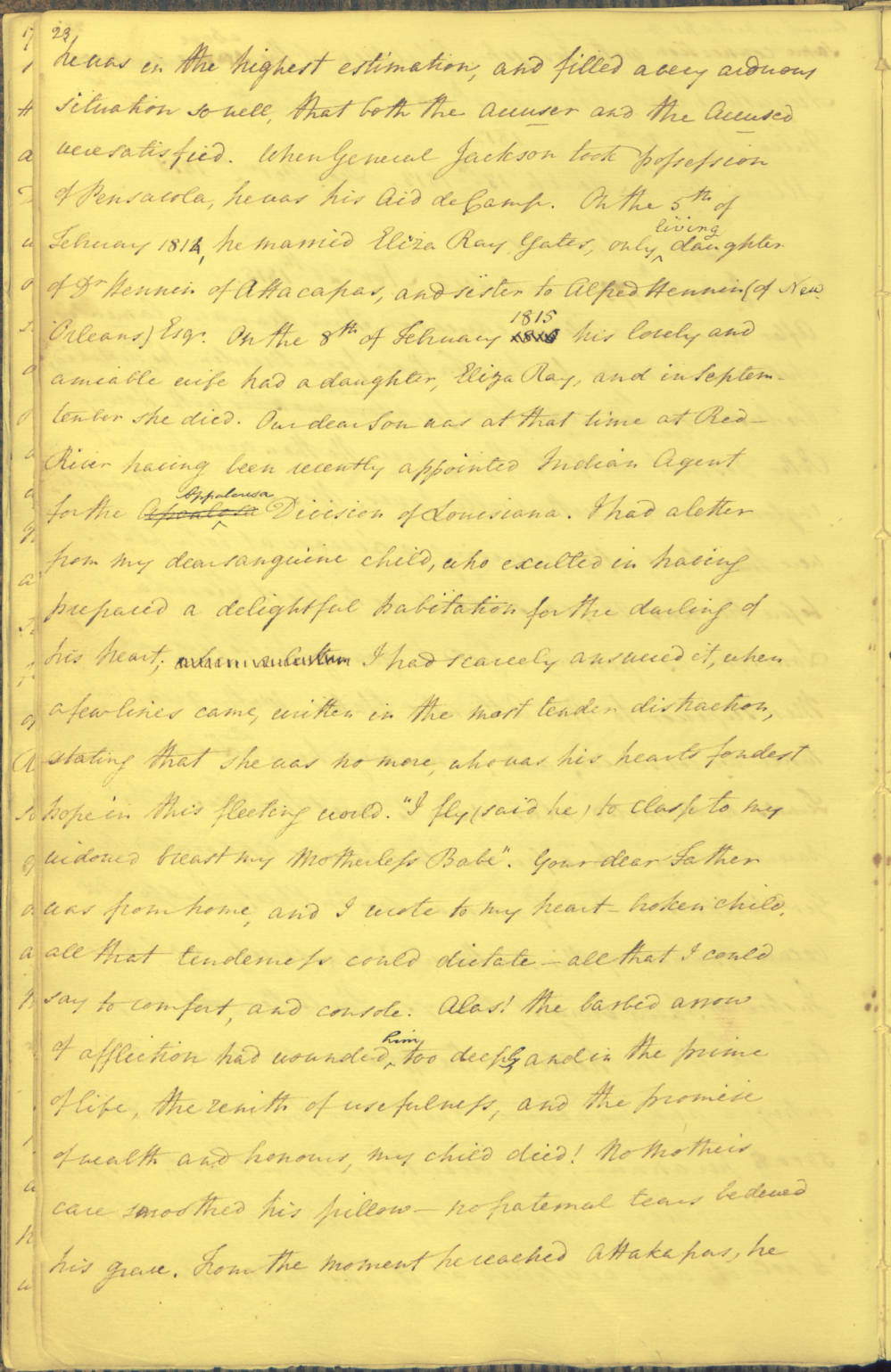
There is a large portrait of a young man with dark, curly hair dressed in a high-collared, braided uniform that hangs in my uncle’s Pat Ferris’ living room.  It is of my fourth great-grandfather Col. Thomas Gales.  My mother has a miniature of this portrait too (see above).  Thomas made much of his short life.  British-born in 1790 to parents with pro-American sympathies, little Thomas lived for a time in a home that was visited by the likes of Thomas Paine and where reading and thinking were always encouraged.  His parents, Joseph Gales Sr. and Winifred Marshall Gales,  were forced to flee England for their political beliefs ending up in Philadelphia before finally settling in Raleigh, North Carolina and founding the Raleigh Register.  Here his father could fully and freely practice his journalism and his mother could pursue her literary aspirations. 
Listing of Judge Advocates in The Judge Advocate Journal June 15, 1944 pp. 14
Once in the US and grown, Thomas' older brother Joseph Gales Jr. pursued journalism like his father and so did Thomas for a time.   But according to his mother, "the business" did not suit Thomas so he took up law studying first under Judge Henry Potter in Raleigh and then with Judge Walter Jones in Washington, DC.  His mentors and friends convinced him that Western Florida or Louisiana were places with opportunities.  So south from Washington, DC he went to New Orleans at a time when his new country was preparing for war with his old.    

From here.
Thomas Gales attracted the attention of General James Wilkinson then senior officer in the US Army and was appointed Judge Advocate of the 7th Military District on September 26, 1812, although it appears he was already advising Wilkinson about his legal powers on the 3rd of that month (see correspondence thread here). We learn much about Thomas during this war from his letters and other documents which link him to many key players in this conflict from the infamous and traitorous General Wilkinson and President Madison to Secretary of War John Armstrong and then Secretary of State James Monroe who later also became Secretary of War (and President).  He was involved too with Andrew Jackson serving as his aide-de-camp for a period until his resignation on December 16, 1814.  He was serving in this role in October and then in November when he was with Jackson at Pensacola where Thomas is said to have removed the Union Jack flying over the city with his own hand.

The header from Thomas Gales' form record of service in the Indian Corps.

Record from Indian member of the Thomas Gales' Indian Corps.
Somewhere in all of this Col. Thomas Gales began working with Indians and Indian troops (see above).  He had his own Indian Corps and was appointed Indian Agent by Louisiana Governor William C. C. Claiborne for the tribes west of the Mississippi in late 1814.  In early 1815, just as he was welcoming his first child Eliza Rae near the one-year anniversary of his marriage to Elizabeth Ray Hennen Yates, Thomas assumed duties at what was known as the Caddo or Red River Indian Agency located in Natchitoches, Louisiana.   I have not found anything indicating exactly when Col. Thomas Gales' Indian Corps was formed but records exist for members with native names as well as names of French, Spanish and English derivation.   It is hard to tell if this group saw any action during the conflict.  I suspect that they might have been the 150 Caddo warriors mentioned here or in this letter to Andrew Jackson in March of 1815.


Eliza Rae Ramsay

Conditions at the Caddo Agency under Thomas Gales worsened (see pp. 93).  It is hard to tell how much of this was the fault of Thomas or just the common problem of a new person coming into replace someone of longstanding with deep relationships with the Caddo leadership during a time of change.  In any case, Elizabeth Gales died in early September of 1815, perhaps of yellow fever, while Thomas was away securing housing for his family in Natchitoches.  Thomas died roughly two months later in his 26th year from some unidentified illness which was probably not helped by his mental state.  They both passed on at the home of his in-laws, Dr. James and Ann Hennen, in Attakapas Parish, Louisiana.  Eliza Rae was raised by relatives and at the age of 23 she married a West Point graduate and widower George Douglas Ramsay.  (Winifred Marshall Gales left a hand-written account of her son Thomas' short life that can be found here: 1,2,3.)

Joseph Gales Jr.  (1844)
It is important to note that while we tend to focus on those nearest the battle lines, with the most braids on their uniforms and in the most peril, we also need to look at individuals and groups who contribute in other ways.  Col. Thomas Gales may have held a captured British flag in his hand, but Joseph Gales Jr. and his brother-in-law and partner William Winston Seaton (both trained by Joseph Gales Sr.) held the young nation's attention and heart through their pieces in the National Intelligencer published in Washington City. Thought both Joseph and William served as privates in defense of the Capitol, I suspect that their efforts with pens were much more impactful than theirs with swords.
From here with more complete discussion of relationship between the National Intelligencer and the Administration.
We must remember too in looking at this that Joseph Gales Sr. was a staunch Jeffersonian Republican and therefore supportive of France and in favor of the war with Britain.  These were views he certainly passed down to Joseph Jr., Thomas and William.  And then Joseph Jr. and William passed those views on to others.  Gales and Seaton were very hard on those who participated in the Hartford Convention and the British were hard on them (see above).  It is interesting too that according to one biographer two of Joseph Gales Jr.'s closest friends were Henry Clay and Daniel Webster.  Names that we have seen before.


Our Story


The War of 1812 is more than two centuries gone.  All those mentioned above are but dust, worn headstones or faint memories.  But are these issues gone?  How, for instance, is this current conflict between Republicans and Democrats fundamentally different than the battle between Republicans and Federalists then?  Yes it seems like the two sides have shuffled the core issues a bit so the parties or functional successors look much different than they did in the days of knee pants and powdered wigs but we are still fighting many of the same sorts of battles.  How is General Wilkinson so dissimilar to General Flynn?  Or alignments to Britain versus France unlike those with the European Union versus Russia of present-day?  Moreover, the need for free and good press to inform and help us sort this out is as needed now as it was then. All things to think about.

I was going to call this piece the 1812 Overture.  But someone had already claimed that.  It turns out a Russian named Tchaikovsky wrote a piece in the 1890s celebrating Russia's repulsion of Napoleon in 1812.  And now we are playing this as we celebrate our independence in our nation's capitol. Those damn Russians sneaking into everything!  (Happy 4th Everyone!)