Showing posts with label Ramsay. Show all posts

Wednesday, July 10, 2019

American Liberty as an N-Dimensional Hypervolume


By Bob Ferris (this is cross-post from my Green Dreams site)

I have always been fascinated with the concept of an ecological niche being characterized as a n-dimensional hyper-volume defined by an infinite number of changing and interacting bio-physical factors.  Phew.  It makes my mind happy.  I like to think about stuff like this on my morning beach walks.  Unfortunately, this idea recently collided with an electronic discussion that I had involving members of a Libertarian organization trying to imply that Oregon was heading towards a "civil war." Their evidence was the recent corporate-sponsored senior prank executed by a group of Republican legislators who walked out and hid during the legislative session to avoid a vote they knew they would lose on cap and trade legislation.  A baby step towards doing something about climate change.  My discussions with the Libertarians really came down to a disagreement over liberty and how it was defined.


The group headquartered in the Northeast and wanting to spread its wings geographically sided with the pranksters as well as the militias and repeatedly argued that you were either with them (i.e., for liberty) or you were a Communist.  There did not seem to be any middle ground.  The bold boys (and they were all male) evidently held that liberty was a single point or maybe a collection of points along a line or in a geometric plane that was free from regulations, taxation, or any form of governmental control or interference.  I disagreed as my sense is that liberty as it was envisioned for the country is more of a hypervolume just like those ecological niches.

I suppose that liberty can be a jumble of points or perhaps a line if you have one person living on a desert island all alone.  But add another person to that island and liberty becomes an exercise of protecting your own and not compromising another's.  Liberty in a multi-person context becomes a set of rights and responsibilities.  No longer can you sing show tunes at three in the morning or pee wherever you want.  With each additional person the structure of liberty and the approaches to protect it become more and more complex.  I think the Founding Fathers understood the tricky and interactive nature of national-scale liberty.


When I was in school I was taught one idea per sentence and one theme per paragraph.  I suspect that Gouverneur Morris who wrote the Preamble was taught that too (in at least a couple of languages) and I suspect that is why the Preamble of the US Constitution reads like a carefully ordered recipe for achieving the desired level of liberty, for the most, and for the longest possible time.  Given the sensitivity for the individual, it was probably an optimization approach rather than one designed for maximization.  I would think that the nod to some individual liberties is a little like the carbon added to iron to make it steel (see below quote).  The iron and carbon analogy is helpful when looking at liberty as our Libertarian friends want all the carbon (personal liberty) they can get which is the recipe for steel blades that break or what is commonly known as pig iron.

“the dignity or moral importance of persons may compensate numbers.” Francis Hutcheson (1694-1746)
Essentially, American Liberty is probably a kind of a highest common denominator concept.  Moreover, this single-sentence paragraph weaves the fabric of national-scale liberty in a manner which implies that weakening any or all of these contributing factors lessens the probability of the latter.  It also is a cloth colored by inclusive words such as union, common, general, and our which give structure to the idea and set the theme of this applying to all of us together.  Roughly a century later Minister Francis Bellamy [1] wrote the Pledge of Allegiance that echoed this collective idea of "liberty and justice for all."  But others came before either.
"The good and happiness of the members, that is the majority of the members of the state, is the great standard by which every thing relating to that state must finally be determined." Joseph Priestley in The First Principles of Government and the Nature of Political, Civil and Religious Liberty (1768)
When you look at the above quote, and similar writings by Francis Hutcheson [2], Jeremy Bentham and other Utilitarians (all influenced by Epicurus), you understand too that the inherent principles of the Preamble did not form in isolation but came from other thinking before, during, and beyond the Revolution.  Few know Priestley now but he can be thought of as the Albert Einstein [3] of the 18th century in that he was a prominent scientist, theologian, and philosopher who left his native England for the intellectual freedom of America.   Joseph was also a friend of Thomas Jefferson as evidenced by more than 150 letters that passed between them and Dr. Priestley is said to have had a "...disproportionate influence on the men who wrote the Declaration of Independence and who framed the Constitution of the United States."

"...convinced that by ruining my family and distressing my friends by risking either, would only gratify the ignorant and malignant, I shall seek that livelihood in another land which I cannot peaceably gain in this."  Joseph Gales Sr. 1794
Priestley was also active in the founding and promotion of the Christian Unitarian Church which acted to reconcile religion and science and attracted the likes of English journalist Joseph Gales Sr and his wife Winifred Marshall who were chased out of England at about the same time as Priestley in 1794.  Gales was a friend of Thomas Paine and published Paine's works as well as those of Priestley.  I know Joseph and Winifred and this story because they are the last immigrants in my bloodline to come to the new world.  I remember a lot of these lost players and discussions for family reasons but others over the years have remembered them as well.

Gifford Pinchot in setting up the US Forest Service coined the phrase: The greatest good to the greatest number of people for the longest time.  His slogan riffs on the words of Jeremy Bentham and also incorporates themes expressed in the Preamble by adding the dimension of time.  Pinchot would have appreciated the idea of the hypervolume as he embraced science and helped found the Yale School of Forestry with the backing of his father.  Pinchot and his brother Amos also joined with Theodore Roosevelt in 1912 in the founding of the Progressive Party which became know as the Bull Moose Party when Republicans of the times were divorcing themselves from the conservation movement launched by Roosevelt and others such as John Muir.  Additionally, Roosevelt was also a fan of Gouverneur Morris so much so that he wrote his biography.

But back to the idea of American Liberty as a hypervolume.  Some might object to my mixing of this scientific terminology with the political.  Too eggheaded.  Too complicated.  I do it for two reasons.  The first is that my idea of ideal liberty is probably different than yours which means that my liberty is defined by a different axis (i.e., dimension) or volume (set of axises) than yours.  Much as I'd like to think mine is a straight and consistent vector it is not and changes with time and conditions as I suspect the vectors of others do as well.  We are human too so we blink on and then off, we multiply, and we move.  Since a hypervolume happens when the dimensions number four or more we are clearly there with nearly 330 million of these often squiggly constructs to consider.


My second reason for using the term is that it is applied to a concept developed nearly two and half centuries ago by some extremely well-educated men who fully embraced the most modern and scientific concepts of their time.  They were hungry for these ideas and proudly carried the banner of the Age of Reason.  I am confident that they would embrace this or something similar to this usage.  They would gravitate to the most complicated and then slice it and dice it in order to understand it. 

In ecological niches those conditions within the confines of the hypervolume tend to support the critter's existence and those outside tend not to.  Viewed through this ecological lens the fossil fuel industry externalizing the environmental costs of their pollution and corrupting legislatures to facilitate that while curbing needed actions on climate change would clearly be outside of even the most generous interpretation of this optimized hypervolume of liberties.  The same would be true of operations like Walmart where society enables the family's profits by subsidizing their workforce while greasing the skids of our manufacturing decline and adding to trade deficits with China.   And I would add that this hypervolume defined by the Preamble would not include nor even consider the notion that everyone has the right to own whatever ordinance in whatever amount they so desire just so arms companies can expand or maintain sales in times of relative peace and that individuals can spray the landscape with lead.  Translated into biological terms it is easy to see why conditions equivalent to these would limit the life expectancy of an animal or population.   Why is it so hard to understand that in the world of the economic and political?

As one can see from the above and the supporting notes below I feel that the Declaration of Independence, the Revolutionary War, and the US Constitution are a little like a Family and Friends plan [4].  This is probably why I was so offended by Trump's 4th of July performance where it was all about the military and very little about the Founding Fathers on the day meant to celebrate their ideas, courage, and sacrifice.  It is like wanting to celebrate the achievements of the honor society at a school but spending your time talking about the football team.  But it is more than that.

The Founding Fathers were thought leaders taking us away from the blind faith and mysticism of religion (while maintaining the best of its moral teachings) and towards developing science and enlightenment.  That is why thinkers, scientists, and journalists like Paine, Priestly, and Gales came to America and flourished [5].  Trump, his evangelical choir willing to believe anything, and others like those who freaked out when the Declaration of Independence was tweeted by NPR in 2017 or the Libertarian group above are madly throwing salt on the fertile fields where this great experiment was launched.  It is not hard to imagine hearing the sound of 56 disapproving cane tips pounding angrily on the floor of Independence Hall in protest.  Hopefully enough others hear the din too in order to affect change.

*****

On a More Personal Note:

[1]
"Bellamy was a Christian socialist who "championed 'the rights of working people and the equal distribution of economic resources, which he believed was inherent in the teachings of Jesus.'" In 1891, Bellamy was "forced from his Boston pulpit for preaching against the evils of capitalism", and eventually stopped attending church altogether after moving to Florida, reportedly because of the racism he witnessed there. Francis's career as a preacher ended because of his tendency to describe Jesus as a socialist. In the 21st century, Bellamy is considered an early American democratic socialist."  From Wikipedia biography of Francis Bellamy
It is interestingly ironic that elements of the forces that argue for the more individualistic and selfish vision of liberty often cling to and revere both the "We the People" phrase and the Pledge of Allegiance not knowing the history of either nor the strongly held beliefs of the authors.  Gouverneur Morris who penned the Preamble and most of the Constitution was an advocate of a strong federal government who wanted to limit state power.  Reverend Bellamy was a Socialist Christian minister who also believed in an absolute separation between church and state.  Both men have ties to Revolutionary War financier Robert Morris in that Gouverneur worked for the older and unrelated Robert and Francis was born in Mount Morris, New York that was named to honor the gentleman who stepped forward with money when it was needed.  My mother read a biography of Robert Morris while she was pregnant with me.  My middle name of Morris relates to brothers Lewis and Gouverneur, but my mother insists that my love of fishing comes from her reading that book as Robert Morris loved to fish and often did so with George Washington and Gouverneur Morris (see Washington as an Angler here)

[2] Francis Hutcheson was a prominent Presbyterian minister and educator in Dublin at the same time as my ancestor Robert Alexander was training for the ministry before heading to the Colonies in 1736.  It would have been hard for Robert not to have had contact with Francis and his ideas.  And harder still for Robert to not pass lessons learned on to his students at the Augusta Academy which eventually became Washington and Lee University after spending time being Liberty Academy about the time of the Revolution.  Robert's grandson Archibald was the fourth president of Hampden-Sydney College (James Madison and Patrick Henry were early trustees) and the founding president of Princeton Theological Seminary.  Hampden-Sydney named for two champions of and martyrs to personal and religious liberty (John Hampden and Algernon Sydney) and started in late 1775 near settlements of displaced Scotch-Irish in Virginia was probably like a match thrown in a pile of already warmed gunpowder.
"Indeed, the original students eagerly committed themselves to the revolutionary effort, organized a militia-company, drilled regularly, and went off to the defenses of Williamsburg, and of Petersburg, in 1777 and 1778 respectively. Their uniform of hunting-shirts - dyed purple with the juice of pokeberries - and grey trousers justifies the College's traditional colors, garnet and grey."  From the History of Hampden-Sydney College.
[3] It has also been said that Priestley was the Abbie Hoffman of his time but I think that works for Thomas Paine better.  It is illustrative to read Paine's critique of Gouverneur's oration at the funeral of Alexander Hamilton to get a notion how Paine might attack those who were once colleagues when they digressed from the purity of Paine's democratic vision.  There is a little bit of the personal here as Gouverneur had both a withered arm and was missing a leg.   I suspect much of that was due to Gouverneur's lack of effort to get Paine released from French prison when Morris was serving as American Minister to France, Paine was a man of fans and detractors.

[4] I have often struggled with the task of characterizing how and where my family participated in the events leading up to the American Revolution and the forming of this nation which is an exercise every bit as complicated as this notion of a hypervolume.  Some of it is easy.  Lewis Morris signed the Declaration of Independence as a representative of New York.  Lewis and the Lewises who came before him are direct ancestors making Gouverneur Morris a long ago uncle celebrated in the middle names of my great-grandfather and my grandmother.  Similarly Joseph Gales Sr. is remembered in the names of my great-great-grandfather, great-uncle, and my sister.  George Washington was a friend of Gouverneur's, but also of Quaker ancestor Benjamin Chew and dined with a young Andrew Ramsay and his wife at Mount Vernon.  It goes on and on much like a well-stirred bowl of spaghetti with strands of angry and educated Scotch-Irish from Ulster, a smattering of exiled Scots that didn't bounce first in Ireland, a fistful of Huguenots, and a collection of Englishmen and women booted or pushed across the pond for various reasons--some religious and others political.  Been there, done that, have the t-shirt.  

[5]

[] I believe that the reverse of this is true as well in that scientists want to leave or not go to areas that do not welcome or respect new ideas or eduction.  The Agricultural Department scientists objecting to being transferred from Washington, DC where 53% of the population have college degrees to Kansas City where only 33% have obtained this level of education is a good example of scientists gravitating to or wanting to stay in areas of enlightenment rather than those where education appears less valued.

Monday, October 1, 2018

The Sadness of Tumbleweeds


By Bob Ferris

Tides ebb and flow.  A little more than three years ago there were four males in my line with the last name Ferris and now with the recent passing of my older brother William Ramsay Ferris Jr. there is just one: Me.  I am wrestling with how I feel about this and it is more complicated than simple loss.

From 2014 with my father and brother in the last photo of all three of us.
Certainly all of these passings in relatively quick succession have affected me and that is not helped any by a political and climatic landscape we now find ourselves in that speaks more of end-of-times than vibrancy and optimism.   The processing of this grief is not ameliorated at all while sucking wildfire smoke, watching dismal weather radars, combating Russian bots, and witnessing the potential collapse of the New World enterprise that our collective family has fought for and then served in various capacities for nearly four hundred years.

My father, uncle, brother, and I were dropped from similar genetic molds, but we differed in beliefs, experience, education, and interests.  We did hunt and fish together and we four also held tight to history and family both current and long past, but we were literally and figuratively all over the map.

We were all also named for those in our Morris and Ramsay lines which adds another onion skin to this complex, because my older brother was also the keeper of much in terms of family history and memorabilia.  This will come to me and I have no children myself and limited space in my retirement downsizing to accommodate walls, bookshelves, file cabinets, or other functional equivalents of family museums.

The garage office I am building for writing and perhaps processing what material might come.
While I am anxious to get the genealogical materials assembled by my grandmother Edna Robb Settles, I fear that some of the other materials will be much more like the links in Jacob Marley's chains.  So blessings and burdens both.  It makes me feel a little like a farmer who no longer has a farm, but will soon have bags and bags of seeds some of which are a couple of hundred years old.  This farmer challenge is exacerbated by the fact that most who care about farming in this sense are old like me and also have their own seeds.  And the younger ones seem to care little about farming.

There are reasons why these roots mean less.  For instance, my father and uncle were born in New York state, my brother in Florida, and I started life in California yet my father passed in Annapolis, my uncle in Atlanta, and my brother in San Jose while I now live in Eugene.  Yes, my two sisters and my mother live in Maryland and Virginia near where many of our lineages landed in the 1600's, but all three of them where born in California.  Moreover, my wife and I have lived in Eugene for six years but we have moved seven times in our nearly fifteen years of life together.  In short, we were once a family of trees that now more resemble tumbleweeds.


I bemoan the fact that my nieces and nephews seem to care little about things genealogical or family history, but I suspect that it is hard to truly appreciate family trees and roots when we are rarely anchored to a hometown and are so constantly moving.  I loved my grandfather and father, but it has been more than forty years since I visited my grandfather's grave in Palo Alto and I have only visited my father's once since his ashes were placed in Arlington.  Neither neglect springs from apathy or paucity of feeling, I think of both most days.  But tumbleweeds tumble...sadly.

Me walking in the Warren, Vermont 4th of July parade with some of my "children" and the Ferris Wheel they built.  
But all is not sadness for as tumbleweeds tumble they drop seeds.  I recall sitting with a group of interns at an informal gathering in a past professional incarnation when one of them asked me whether I had any children.  When I answered that I did not she countered claiming that they were actually all my children.  It was a nice thought and I think that I will work to embrace it as I process the pile before me and that which age and circumstance has brought to us all.   


Tuesday, July 24, 2018

The Day Horror Met Hoodoo on the Columbia

Here
By Bob Ferris

I have lived in the Pacific Northwest for nearly a decade now which made Major Samuel Canby's grave in Vancouver, Washington a curiosity to me.  How did a Brandywine-born Quaker with a Viking last name end his days across the continent in Washington State just days before his 60th birthday?  My interest was also piqued because while I knew quite a bit about all my other ancestors in this generation, I knew next to nothing about Samuel other than his birthplace and where he breathed his last.  It was a mystery, so I dug and found the below which only made it even more mysterious...and tragic too.

July 24, 1897 from here.
Samuel Canby was my great-great-grandfather and he was born in 1837 into a prominent family of millers in the Wilmington, Delaware area.   The Canbys along with the Tatnalls and Prices were big doings in Wilmington and young Samuel carried within him the blood of all three families.  Though identified as Samuel Jr. on many documents his father's name was Edmund so I believe that the junior was added so he was not confused with his uncle of the same name.


Samuel Junior served in the Union Army during the American Civil War joining less than two weeks after the attack on Fort Sumter.  When you look at his service record you find that young Samuel enlisted at 23 as a sergeant in a New Jersey regiment but soon found himself in units associated with his native Delaware (above).  It was during his switch between state affiliations that he married Rebecca Tilghman Johnston in December of 1861 and then he went to war in earnest.

Depiction of Union charge at Gettysburg
Saying that he served seems like such a simple statement, but I suspect that it is like claiming an atom bomb is just another loud bang.  The newly-married Samuel was at the battles of Shiloh, Fredericksburg, Chancellorsville, Gettysburg, Franklin, and Nashville.  He was wounded at Gettysburg and by age 28 he was a major.   He left the Army in 1868 and by then he and Rebecca had three children.  He had as they said at the time "seen the elephant."

Now I have not been able to find much on-line about Samuel and Rebecca for the period between 1868 to 1894 when Samuel seemed to appear sans Rebecca in Vancouver joining his younger brother Edmund.  Certainly Samuel and Rebecca were together and still having children until their last, William Poyntell Canby, was born in 1879.  And they were listed in an 1880 census in Delaware with Samuel's profession given as Civil Engineer--the same as my great-grandfather, William Gouverneur Ramsay, and my father, William Ramsay Ferris, who were both majors too. 


Samuel's profession explains, in part, why he would find himself manager of the nine-year-old Vancouver, Klickitat, and Yakima Railroad.   The other part was that the railroad was founded by his brother Edmund and others associated with the then extant First National Bank of Vancouver.  Hard to say the deciding factor in his hiring and it could have been a chicken and egg situation.  But we do know on that fateful day in July, Samuel was seen off in good spirits by his brothers Edmund and Col. James Price Canby and not by Rebecca who remained in Wilmington.  And this is where the hoodoo enters.

The stern-wheeled steamer Mascot.
The steamer Mascot was built in 1890.  Fast and long-lived for an all-wooden boat (21 years), the Mascot ran a strenuous route from the Lewis River in Washington to Portland, Oregon and points on the Willamette River six days a week starting at 5 AM.  This was a profitable run but the boat seemed plagued with miss-haps including three sinkings, several deaths (two by suicide), and the fire in 1911 that finally ended its service.  For these incidences, rightfully or wrongly, the steamer was labeled as a "hoodoo" or jinxed ship


 It was from this "hoodoo" that the troubled Samuel jumped into the Columbia River after throwing his coat on the deck and tossing his hat towards the boiler room doors 121 years ago today.  No one knows but Samuel what was running through his mind as he stood on the rail before launching himself for his last swim, and there is much we do not know about his life and condition at that time, but I cannot think that what he experienced at battlefields like Shiloh and Gettysburg was not somehow involved in the calculus of it all.  Those war days had to have left a mark beyond whatever physical scar he carried from his wounding.

Here is a key written from the perspective of one of the Ramsay girls children of Caroline (Lena) Johnston Canby.  

Some in my family and elsewhere will likely be offended some by this post and see it as a familial stigma that I have exposed to the world.   I do not see it thus but rather a cautionary tale about looking after our loved ones and keeping them from harm as well as a larger story about the value of maintaining peace and the dangers of war.  And it is not necessarily a totally unhappy spinning either as Samuel and Rebecca in spite of this inner storm and consequence produced a pile of Canbys (some above).

I do not know for certain whether or not my lack of knowledge about Samuel was a direct result of how he ended his life, but I suspect it contributed.  We are a family of great men and strong women that seems to respect courage and toughness foremost with not much room allowed those who are born vulnerable or damaged while trying to live up to this ideal.   I would think that a heightened awareness and openness on this topic of suicide could probably prevent some of these occurrences as well as help ease the pain for those left behind when they do happen.

George Britton Compton

Samuel's great-grandson George Compton (above), who we all knew in our household as Uncle George, committed suicide when I was about seven or eight just before his 40th birthday.  To this day there still seems confusion about the root causes of that happenstance but I do not think that people asked adequate questions nor watched him closely enough at the time.  This is also one of the reasons I never met my own grandfather Van Wyck Ferris who left this world similarly.  Perhaps we would do better by Samuel, Van, George, and others not mentioned by employing a different approach that celebrated their victories, recognized and accepted their challenges, and did not ostracize them for the way they passed.    It is something to think about.

Afterword

I believe my late father once identified the young girl at the far left in the Canby photo as Caroline Johnston Canby Ramsay and one of the young boys at the right as Uncle Poynt (William Poyntell Canby) which would date this to the mid to late 1880s.  I suspect that one of the children is also the artist Ethel Canby Peets who was two years older then Poynt.  I do not know, but if others do, please let me know.  The story and picture haunts me.  (Cousin Wyn Evans was kind enough to provide a key above.)

Saturday, June 30, 2018

For the Revolutionary War Our Family Turned it Up Above Eleven and Now We Need More


By Bob Ferris

I have butted heads with the so-called "patriot" groups over the years on various matters relating to the US Constitution, conservation practices, and public lands.  One group in particular drives me crazy: The 3 Percenters.  This para-military group claims to be the voice of those 3% of Americans who served in militias during the American Revolution.  This number is a little specious both in terms of a measure of patriotism (i.e., militia members being more patriotic than those in the Continental Army) and gross numbers as overall participation in this conflict was something like 15 percent.  It made me wonder where our family came out in this number and what that means now and in the future.

The Revolutionary War started in earnest 243 years ago.  As male generations are on average 35 years long, or 15 years longer than female generations, that means we should be talking about males in the seven or eight generation or between 64-128 potential soldiers in the Revolution.   As we have at least 17 Revolutionary War combatants in our tree or 13-26 percent of our expected pool that means that we might have collectively served a little less or a lot more than the average population at 15 percent.

But it is more complicated than that.   For one thing, males had to be a certain age (16-55) during a certain window of time (1775-1783) so we might have had some who were alive during war, but too old or too young.  This said we also had instances where both father and son served such as Declaration Signer Lewis Morris and Lt. William Walton Morris (not to be confused with his son Gen. William Walton Morris who served in the Civil War).   And we had a few who were not in the country at this time such as Patrick Ramsay (Scotland), William Poyntell (England), and Joseph Gales Sr. (England), the latter my family's most recent immigrant (1790s). 

David Deschler

Joseph Tatnall
Benjamin Chew

Also mainly through my great-grandmother Caroline Johnston Canby Ramsay on my father's side, there is a strong Quaker connection.  Three of note were David Deschler, Joseph Tatnall, and Benjamin Chew.  Interestingly, all three hosted George Washington in their homes at times, but they dealt with their pacifism and the war in different manners.  David was perhaps the most involved providing supplies, money, and eventually serving as the Commissary of the Army in 1780.    David was also a man of principle supporting the Revolution, but also once defending a British officer who was traveling with his family from an angry crowd of militia members in Philadelphia.  Joseph Tatnall, a mill owner, also worked hard to keep the Continental Army in flour and had constant contact with Washington.  Benjamin Chew stuck to his material neutrality offering only legal advice to those serving in the Continental Congress and advocating for protest leading to a peaceful resolution rather than declaring independence.  While David and Joseph retained the full goodwill of their neighbors and new countrymen, Benjamin's road, because of his why-can't-we-all-be-friends approach, was rougher.

Those who served were old and young.  Though my mother has told me often of a little drummer lad in the family who went to war I have yet to discover that intrepid boy.  The youngest I have been able to find is Ensign John DePeyster Douw who joined at 19.  The oldest was Colonel Samuel Coit who led his Connecticut regiment for a year before being replaced at age 73.  They also came from nearly every colony so there was diversity in this regard if not in other areas.
"Mrs. Johnston died in that city, but we have no record of the date of her death or where interred."  In Some Pennsylvania Women during the War of the Revolution (1898 see here).
But what about the women?  The above quote says a lot about that issue.  The Mrs. Johnston in question was Alice Erwin Johnston wife of Colonel Francis Johnston and she broke with her Quaker community and worked hard to get food and supplies to soldiers during the war.  This was particularly true about Valley Forge where her husband served with Washington and another Francis (Chaffin) who died there of small pox even with the efforts of Alice and her allies.  Luckily, we actually do know where Alice was buried and then reburied, but even in a book dedicated to acknowledging the role of women in the Revolution details about women were omitted or overlooked.  Odd that.

This walk through history is interesting but how do we judge it and our collective role?  What does it mean for the future?  In essence, what is the point?  My sense is that revolution is much like soil tilling in that it gives a clean slate on which to grow dreams like those expressed by Gouverneur Morris in the Preamble.  Perhaps we should not be measured by the quality or quantity of our disturbance as I have documented above, but by the crops ultimately produced.   And even there my desire would be that we evaluate ourselves more by the flowers nourished and enabled rather than just in terms beets and broccoli.

Alexander Johnston Cassatt by Mary Cassatt.  Alexander helped his sister promote her art in the US.  They are both great-great grandchildren of Alexander Johnston who immigrated from Ireland and was father to Francis.  
Our families have a lot of these exceptional "flowers" growing from various branches.  I bumped into two, in addition to Alice Johnston, while writing this piece.  The first was the impressionist painter Mary Cassatt who called Colonel Francis Johnston great-great uncle.  I knew of her connection to the Johnston line but not of her brother's efforts on her behalf.  The other was Lillie Hitchcock Coit of San Francisco's Coit Tower fame who was married for a time to Benjamin Howard Coit great-great-great grandson of Colonel Samuel Coit.  In this in-laws count just as transplants do in a garden.


Illustration from one of Mary Lanman Douw's books.  The Rapelye (Rapalje) cradle was where Sarah Joris Rapalje was rocked after being born in the New Netherlands in 1625.  She was the first female child born in the new colony at Fort Orange (Albany).

In addition to a painter and fire-chasing, trouser-wearing philanthropist in our extended family we also have writers.  One such was Mary Lanman Douw who wrote much about history, genealogy, and the early Dutch experience in the New World.   Nina Chandler Murray is another author who penned a book about an epic family cruise to the Galapagos Islands.  I would also include Winifred Marshall Gales, the first female novelist in North Carolina, within this group too even though she was in England during the Revolution, because her public sympathy to this revolt and breaking away led to her and her husband Joseph Gales Sr. being chased out of England one step in front to the law.   The fact that the Gales entertained folks like Thomas Paine of Common Sense fame in their home and printed some of his material probably helped along this process of moving from liking the American stance to being American.

Award-winning teacher Lauren Bergland Rosenberg at work.

My grandmother Edna Dora Robb also was one of these flowers.  She wrote about her experiences in post-World War I Alaska in Field and Stream Magazine, but she is better known as a school teacher who as a single woman went to the relative wilds of Seward to teach before marrying my grandfather at the start of the Roaring Twenties.  And there are other teachers too like second cousins once removed Lauren Bergland Rosenberg (above) and Patty Lavarias who are both probably going to look at my grammar. 


In closing, I will say that we are living in dark times, but the strength, creativity, and sensibility of the women in our families and lines gives me hope.  I gain this feeling, because these women might be the ones who inspire or lead this next revolutionary adjustment or needed democratic booster shot.  Maybe they can do so in a better and more enlightened manner than our more recent forbearers did in the mid-1800s.  It might also be good time for those of us not women to model Alexander Cassatt by recognizing this talent, however different, and supporting it.

The above is something that we should think about this July 4th as we celebrate the work of our Founding Fathers and simultaneously mourn how far we have drifted away from our founding principles and the vision expressed in the US Constitution.  We need to return to protecting all within our country from the corrupting forces of a too-empowered elite, over-entitled corporate interests, and the dangerous re-emergence of the functional equivalent of a state church or religion.  We should recognize this trio for what they are: the catalysts for the original Revolution.  So enjoy the fireworks, but get your shoes ready to march on as the fife and drum are calling!
 

Monday, September 11, 2017

Mistaken in Maryland

The Mark of Richard Johns on a piece of pottery from Angelica Knoll in Maryland (Note: He was a Quaker rather than a Catholic)
By Bob Ferris

I might have, once or twice, when I first moved to Maryland called Johns Hopkins University incorrectly John Hopkins thinking it titled after a person named John rather than someone named Johns Hopkins honoring the melding of two early Quaker families in Maryland.  I was corrected and learned.  Fancy that.  Then I filed away this information until I started looking at the collection of ancestors that I had in Maryland--many of them from the Society of Friends or Quakers.

This took me to Richard Johns, Elizabeth Kensey (Kinsey) and a place called Angelica Knoll.  The Johns were very active Quakers, but at the same time not strict in all their beliefs and practices.  Richard Johns (1) was devout enough to help establish a Friends Meeting House (1,2,3) near their home called the Clifts or Cliffs close to Calvert Cliffs which was visited by Quaker Founder George Fox.  Yet Richard consumed hard cider and brandy as well as having an extensive library.  Richard also did not dress drably as others of the sect did.

Initials on a "bodkin" found at Angelica Knoll that likely belonged to Margaret Johns (Is could be Js.) 

Elizabeth and Richard also had children which made the Clifts and Angelica Knoll something of a familial epicenter of sorts.  Why a family epicenter?  Well, Richard and Elizabeth (1) had two daughters, Pricilla and Margaret.  Pricilla married Robert Roberts (the elder) who went north from Maryland and is an ancestor of my father William Ramsay Ferris.  Pricilla married into a line that eventually connected with the Canbys (1,2) and my great-grandmother Caroline Johnston Canby who many of us knew as Nana.  Nana remained a Quaker and in this light it is interesting that she married into so military a family as the Ramsays.


And Margaret Johns married Gerard Hopkins who are ancestors on my mother's side.  The Hopkins' line moved west appropriately marrying into the West family and eventually connecting to the Settles family in Pike County, Missouri.   My mother was born Mary Robb Settles.

The Descendants of Pricilla and Margaret Johns reunited in a single family after more than three centuries (Front Row (L-R): William Ramsay Ferris and Mary Robb Ferris [Settles]. Rear Row (L-R) William Ramsay Ferris Jr, Mary [Gales] Ferris Siebert, Caroline Robb Hall [Ferris], Robert Morris Ferris.) 
As both my parents had ancestors on the Mayflower their families had nearly 400 years to mix and create common ancestors. It is interesting given this time and opportunity that Richard and Elizabeth Johns seem to be my parents' only common ancestors on this continent.  (There may be more, but I have not found them.)
Johns Hopkins
Of note in the beginning context are Margaret and Gerard (Gerrard) Hopkins.  This couple celebrated both their families by naming one of their sons Johns Hopkins.   That first Johns Hopkins also had a grandson of the same name born in Crofton, Maryland in 1795 who attended the Anne Arundel Free School in nearby Davidsonville, Maryland for a time (1807-1809).   Johns Hopkins was an astute businessman and investor who became very, very rich and was able to retire at the age of 52.

That later Johns Hopkins ended life childless having fallen deeply in love with his first cousin Elizabeth who he was forbidden by their religion and custom to marry.   In fact, neither of them ever wed and John Hopkins took his money--some seven million dollars--and put these funds and others towards Johns Hopkins University and the hospital that also bears his name as well as an orphanage specifically for children of color.   This latter action is of significance as Johns Hopkins' family owned slaves which they released in 1807 and Johns Hopkins was a prominent Abolitionist.
“...slavery was perfectly acceptable provided that slave owners attended to the spiritual and material needs of those they enslaved.” On Quaker attitudes towards slavery in Slavery in Colonial America, 1619-1776 by Betty Wood
My sense is that we cannot heap praise on Johns Hopkins for his actions and attitudes without at the same time acknowledging that many of our ancestors, including those of a Quaker or "friendly" persuasion like the Johns, Chews and Galloways in Maryland, owned slaves.  They were not alone as something like 70% of Quakers owned slaves near the turn of the 18th century.   And, yes, the Quakers were among the first in the Colonies to push back on the practice reducing ownerships to 10% by the mid-1700s and very early on joining the Abolitionist cause.  But they were owners regardless of how benignly they treated those removed from their homes in Africa and elsewhere.  And perhaps while we argue for all to model Johns Hopkins' philanthropy and tolerance we should also offer up a certain openness to discuss this other difficult topic as well.  Seems like all these actions are need now more than ever.


Friday, September 1, 2017

The Need for Graham Crackers


By Bob Ferris

I think at times that the above is what I need.  Folks who can "crack" the mysteries of our two Grahams—James and Richard—two men who arrived in the Colonies in separate centuries as if dropped from thin Scottish air.  Interestingly, they were both rumored to be connected to notable men in ways that seemed perhaps impossible.  But still the rumors persisted and for a lot of good and bad reasons. Let's start with one un-cracked and finish with the one that is confusing but more certain. 


James Graham sailed from Great Britain on the Blossom with newly appointed Governor Edmund Andros in 1678 at the time when England took possession of the Dutch Colony renaming it New York.  James was a mover and shaker quickly becoming an Alderman, the first recorder of New York City, and serving in the legislature in addition to being Attorney General under differing political configurations.  He also liked his "cyder" evidently and was famously stabbed and nearly killed by Captain Jarvis Baxter after they imbibed.  In short, he had a big footprint in the colonies but a surprisingly clouded past in Scotland.  

From A Dictionary of Scottish Emigrants to the US
The written record on James varies.  Some sources just jump to him being the son or grandson of James Graham the Marquis of Montrose and then move on.  Other sources acknowledge this has been claimed and then offer up a close relation hypothesis because of his having the family seal.  None of these approaches gains virtue through actual evidence but only because of repetition. Many sources give John Graham as his father and Isabella (Isobella or Isabel) as this mother.  His purported mother's maiden name is given variously as Auchinleck, Affleck or Affick which are related in a fashion.  I just do not know for certain.

Auchinleck House in the area where this Isabella would have lived. The house was build a century later.
James Graham Marquis of Montrose did have a son named John but that son died in 1645 at the age of 15 before our James was born.  James of Montrose did have other sons but they were either well documented as not being our guy's father or too young to have a child in the 1650-1656 period in question. I thank the kind and responsive folks at the 1st Marquis of Montrose Society in Scotland and the Clan Graham Society on this side of the pond for helping me sort possibilities and rule out those that are obviously incorrect.  Much appreciated.

This is a mystery and one that is hard to abandon because of the oft repeated myths and the story of the seal which no one seems to know about anymore.  The connection makes sense and more tendrils of clues emerge because the lands held in New Jersey by Gov. Lewis Morris and Isabella Graham Morris were called Monmouth in honor of the Morris roots in Wales but within those lands is also the town of Montrose, New Jersey a head nod to the Grahams.  So the mystery remains and the clues tug at us.


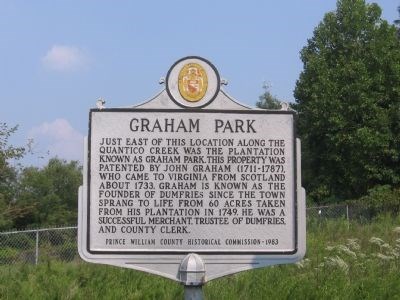
Richard Graham is another ancestor that needed cracking.  At first glance he seems, like James Graham, a Lowland Scot who appeared or was born in North America fully-hatched with unclear roots.  He, like ancestor Patrick Ramsay's son Andrew who married Richard's daughter Catherine (see above), was associated with Dumfries, Virginia named after the same in Scotland.  Dumfries was founded by John Graham who was born in 1711 but John is not Richard's father as he did not seem to have a son named Richard although John did appear to have connections with the Grahams of Montrose.


Patrick Ramsay was a merchant tied through his father Andrew Ramsay to the so-called tobacco lords of Glasgow.   Graham was a merchant as well first associated with the firm of Morris and Nicholson out of Philadelphia that had Robert Morris, signer of the Declaration of Independence and financier of the American Revolution, as a controlling partner.  Graham dealt in tobacco also but was more of a land speculator occasionally connected to the likes of George Washington (1),  Thomas Jefferson (1) and George Mason IV (Richard's son George married the widow of George Mason V).  In the letter cited to Thomas Jefferson, Richard writes that he has connections to the Marquis of Graham (6th Marquis of Montrose) but does not define those.  It all confuses.

From here written by George Mason Graham Stafford grandson of George Mason Graham.

In terms of purported links to great ancestors, I was given a genealogy at one point that claimed Richard was related to the Grahams of Norton-Conyers in Northern Yorkshire.  Since this felt like a stretch and no documentation was given I was dubious.  That was until I found the above account that linked our Richard through his grandson George Mason Graham to Reginald Graham, the second Baronet of Norton-Conyers.  There are Richard Grahams in this line, however, the dates appeared to not line up.   The Sir Reginald in question died in 1728 which makes it unlikely he fathered a child ca. 1755 and our Richard Graham lived with the Dumfries crowd and claimed an association with Montrose.

From here.
Then I found the above hint and was able to backtrack and find that Reginald Graham, second Baronet, did indeed have a son named Richard (1,2) who married a woman named Cordelia Chaloner in Cumberland County, England. I was also able to find numerous mentions of their two sons Richard and Reginald Graham in Dumfries, Virginia so I continued to look and then located a reference to a Reginald Graham who died in 1782 and whose estate was administered by George Graham, William Carr and Richard Graham.  Though not absolutely certain, this is a much more solid place than where I started.

Norton-Conyers Manor home of the Grahams since 1624 and supposedly the inspiration for Thornfield Hall in Jane Eyre
Accepting this lineage opens a large door in our line that travels to Sir Richard Graham, the first Baronet of Norton-Conyers and to his father Sir Richard Graham (1) of Esk.  It even leads us to Fergus Graham of Plomp.  But there it re-enters the murk as evidence gets thin when trying to document links with the likes of Mathias (Matthew) Graham or John of the Bright Sword.  It seems appropriate though as these Grahams lived for centuries in the borderlands between Scotland and England which included Cumberland and also an area know as the Debatable Land.  Debatable, indeed.


Perhaps I look at this in a backwards manner for both James and Richard.  Maybe they are the roots themselves?  In the critical two centuries of this nation's transformation from colonies to country and then the protection of that entity through three wars these two dropped many important acorns (see below). It is interesting in this that when the children of William Walton Morris and George Douglas Ramsay married during the Civil War they brought together the Montrose and Menteith elements of the Clan Graham again.  It is always nice when symmetry is obtained.

Partial List of James and Elizabeth Graham's Descendants:
Isabella Graham Morris, First Lady of New Jersey
Robert Hunter Morris, Governor of Pennsylvania
Lewis Morris III, Signer of the Declaration of Independence
Gouverneur Morris, Writer of much of the US Constitution
General Staats Long Morris, British General serving in India and then Governor of the Quebec Garrison
Honorable Richard Morris, Chief Justice New York Supreme Court
Lewis Richard Morris, US Congressman
General William Walton Morris, Civil War General

Partial List of Richard and Jane Graham's Descendants:
Captain George Graham, Calvary Captain in the War of 1812 and Acting Secretary of War under James Madison.
John Graham, Diplomat
George Mason Graham, West Point Graduate and the Father of Louisiana State University
General George Douglas Ramsay, Chief of Ordinance for the Union during Civil War
Admiral Francis Ramsay, Civil War Ship Captain and Chief of the Navy's Bureau of Navigation